
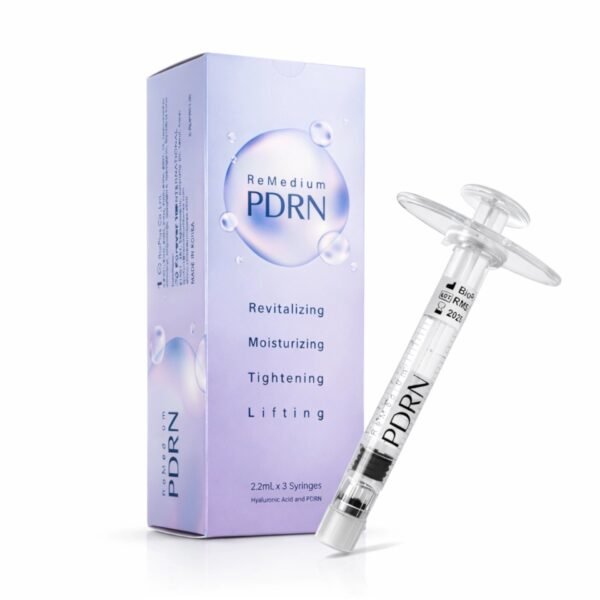
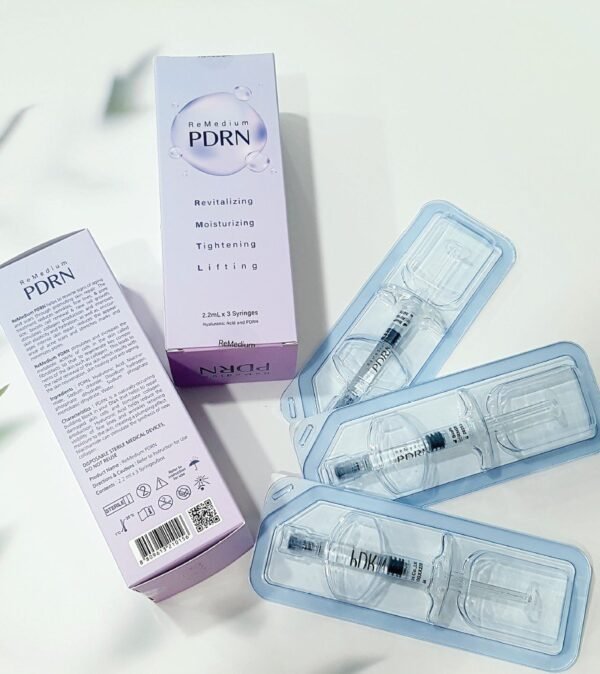
REMEDIUM® PDRN Skin Revitalizer (Box of 3 Syringes × 2.2 mL) | South Korea
Short Description
A pharmaceutical-grade, pre-filled regenerative biostimulating injectable formulated with ultra-purified Salmon-derived Polydeoxyribonucleotide (PDRN) suspended in a non-cross-linked physiological Sodium Hyaluronate carrier. Packaged in an ergonomic clinical presentation of three 2.2 mL pre-filled sterile glass syringes (6.6 mL total box volume), REMEDIUM® PDRN activates cell-surface Adenosine $A_{2A}$ receptors and fuels the cellular purine salvage pathway—stimulating microvascular angiogenesis (VEGF), clearing subclinical micro-inflammation, and driving de novo Type I/III neocollagenesis to reverse photo-damage, smooth atrophic scarring, and restore cutaneous elasticity.
Detailed Description & Cellular Mechanism of Action
REMEDIUM® PDRN (3 × 2.2 mL Syringe Presentation) is an advanced, sterile, non-pyrogenic intradermal injectable developed in South Korea. While multidose mesotherapy vials require aspiration via draw-up needles, the pre-filled glass syringe format provides an airless, closed-system delivery that preserves polymer chain integrity, reduces preparation time, and provides consistent extrusion force.
Extracted from wild salmon germ cells (Oncorhynchus keta), the bio-fermented PDRN chains demonstrate a >95% structural homology to human leukocyte DNA, ensuring biological integration with negligible antigenicity. The formulation functions via three synchronized biological pathways:
-
Adenosine $A_{2A}$ Receptor Ligation (Resolution of Chronic Micro-Inflammation):
-
PDRN fragments (50–1,500 kDa) act as selective agonists for cell-surface Adenosine $A_{2A}$ receptors located on macrophages, fibroblasts, and endothelial cells.
-
Receptor engagement downregulates pro-inflammatory cytokines (including TNF-$\alpha$, IL-1$\beta$, and IL-6) while upregulating anti-inflammatory mediators (IL-10).
-
This rapid anti-inflammatory shift suppresses matrix metalloproteinase (MMP) activity, halting the enzymatic breakdown of endogenous dermal collagen and elastin.
-
-
Purine Salvage Pathway Utilization (Accelerated DNA Synthesis & Mitosis):
-
Cellular endonucleases cleave the polynucleotide polymers into bioavailable nucleotides and nucleosides.
-
Rather than expending metabolic ATP on complex de novo purine synthesis, senescent fibroblasts and basal keratinocytes incorporate these donor fragments directly via the Salvage Pathway.
-
This accelerates cellular DNA transcription and repair, shortening the mitotic cycle and speeding epidermal re-epithelialization in photo-damaged, thinned, or post-ablative tissue.
-
-
Capillary Angiogenesis & Fibroblast Proliferation (VEGF Expression):
-
Intradermal deposition triggers sustained secretion of Vascular Endothelial Growth Factor (VEGF) and basic Fibroblast Growth Factor (bFGF).
-
The resulting capillary sprouting improves microvascular perfusion to ischemic dermal planes, supplying amino acids and oxygen required for the deposition of organized, triple-helical Type I and Type III collagen bundles.
-
-
Viscoelastic Hyaluronic Acid Carrier Matrix:
-
The uncross-linked HA matrix binds extracellular water immediately upon injection, expanding the dermal interstitial space to distribute the PDRN macromolecules evenly across the tissue without localized clumping.
-
Treatment Areas & Clinical Indications
-
Pan-Facial Biorevitalization & Tissue Remodeling:
-
Chronically dehydrated, dull, and sallow skin showing solar elastosis (Glogau types II–III)
-
Superficial dynamic and static rhytids (forehead horizontal creases, perioral barcode lines, accordion smile lines)
-
Enlarged follicular pores and rough cutaneous micro-relief
-
-
Periorbital Micro-Crepeyness & Tear Trough Transition:
-
Crepey, thinned skin of the lower periorbital envelope
-
Bluish vascular dark circles secondary to dermal translucency
-
-
Cervical & Décolletage Rejuvenation:
-
Transverse horizontal neck bands (“necklace rings”) and platysmal skin crepeyness
-
Cleavage sleep creases and solar poikiloderma across the upper chest
-
-
Atrophic Scars & Cutaneous Fibrous Defects:
-
Post-acne atrophic rolling scars and shallow boxcar depressions requiring dermal bed expansion
-
Hypotrophic surgical incisions and distended striae (Striae Albae / Rubrae)
-
-
Post-Procedure Cutaneous Rehabilitation:
-
Accelerating barrier recovery, suppressing post-inflammatory erythema (PIE), and preventing post-inflammatory hyperpigmentation (PIH) following fractional ablative lasers, radiofrequency microneedling, or deep peels
-
Key Clinical Advantages
-
High Total Treatment Volume (6.6 mL per Box): The $3 \times 2.2\text{ mL}$ format delivers 6.6 mL of total product—sufficient to cover the entire face, neck, and décolleté in a single intensive session, or to supply an entire 3-session induction protocol for targeted facial areas using 1 syringe per session.
-
Ready-to-Use Pre-Filled Syringe Design: Eliminates needle draw-up from vials, maintains strict sterility, and offers direct compatibility with micro-injection needles and blunt cannulas.
-
Balanced Viscoelastic Extrusion: Engineered with calibrated shear-thinning rheology, enabling smooth extrusion through ultra-fine 32G or 34G needles without syringe stalling or hand fatigue.
-
Rapid Clinical Downtime: Non-cross-linked and highly biocompatible, intradermal micro-papules absorb and flatten within 12 to 24 hours post-treatment.
-
100% Free of Chemical Cross-Linkers (BDDE-Free): Clean metabolic degradation through endogenous nucleases and hyaluronidase with no risk of late-onset immune granulomas.
Administration Techniques
-
Intradermal Micro-Papular Technique (Precision Needle):
-
Use a 32G or 34G (4 mm) needle inserted at a 30° angle into the upper reticular dermis.
-
Deliver micro-blebs of 0.02 to 0.05 mL per point, spaced 5 to 8 mm apart across the treatment grid.
-
-
Blunt Microcannula Retrograde Fanning (Minimal Trauma):
-
Create entry points with a 26G pilot needle lateral to the zygomatic arch or near the mandibular angle.
-
Advance a 27G (38–50 mm) blunt-tip microcannula into the immediate subdermal/deep dermal interface.
-
Lay down linear retrograde threads of 0.05 mL per pass in a cross-hatching vector.
-
Technical Specifications
| Parameter | Specification |
| Product Classification | Regenerative Polynucleotide Skin Booster / Intradermal Bio-Implants |
| Brand / Origin | REMEDIUM® / South Korea |
| Packaging Presentation | Box of 3 x 2.2 mL pre-filled sterile glass syringes (6.6 mL total) |
| Primary Active Substance | Ultra-Purified Salmon-Derived Polydeoxyribonucleotide (PDRN) |
| Carrier Hydrogel | Non-cross-linked Sodium Hyaluronate (BDDE-Free) |
| PDRN Molecular Weight | 50 – 1,500 kDa (calibrated for cellular salvage uptake) |
| Lidocaine Content | Lidocaine-free (compatible with topical anesthetic cream prior to injection) |
| Target Injection Planes | Superficial to mid-dermis, epidermal-dermal junction, or immediate subdermal plane |
| Recommended Instruments | 32G / 34G (4 mm) micro-needles or 27G (38–50 mm) blunt microcannulas |
| Standard Treatment Protocol | Induction: 3 sessions spaced 3 to 4 weeks apart; Maintenance: 1 session every 4 to 6 months |
| Papule Absorption Time | Resolves within 12 to 24 hours post-injection |
| Expected Clinical Duration | 6 to 9 months cumulative tissue regeneration following an induction cycle |
| Storage Instructions | Store between 2°C and 25°C (36°F to 77°F); protect from light and freezing |
| Regulatory Status | Professional Medical Aesthetic Injectable / Rx Only |
Comparative Benchmark: Pre-Filled Syringe PDRN / Polynucleotides
| Parameter | REMEDIUM® PDRN (3 x 2.2 mL) | REJURAN® Healer (2 x 2.0 mL) | PLENHYAGE® XL Strong (1 x 2.0 mL) | PHILART® (1 x 2.0 mL) |
| Origin | South Korea | South Korea (PharmaResearch) | Italy (Bioformula) | Italy / Austria (Croma) |
| Packaging Presentation | 3 Syringes × 2.2 mL (6.6 mL) | 2 Syringes × 2.0 mL (4.0 mL) | 1 Syringe × 2.0 mL (2.0 mL) | 1 Syringe × 2.0 mL (2.0 mL) |
| Active Molecule | PDRN + Linear HA Carrier | High-viscosity PN (20 mg/mL) | High-concentration PN (20 mg/mL) | Purified PN (20 mg/mL) |
| Syringe Volume | 2.2 mL per unit | 2.0 mL per unit | 2.0 mL per unit | 2.0 mL per unit |
| Extrusion Viscosity | Low-to-Moderate (Shear-thinning) | High (Viscous gel) | Moderate-to-High | Moderate |
| Needle Sizing | 32G – 34G / 27G Cannula | 33G – 34G needle | 30G needle | 30G needle |
| Post-Care Downtime | 12 to 24 hours | 48 to 72 hours (visible blebs) | 24 to 48 hours | 24 to 48 hours |
| Primary Clinical Focus | Hydro-regeneration, acne scars, tone | Deep structural dermal density | Severe elastosis, scar remodeling | ECM remodeling, photoaging |
Professional Advisory: REMEDIUM® PDRN (3 × 2.2 mL) is intended strictly for certified dermatologists, plastic surgeons, and credentialed aesthetic physicians trained in intradermal injection techniques. Direct intravascular injection is strictly contraindicated. While salmon DNA is highly purified and deproteinized, patients with severe, anaphylactic fish or seafood allergies should undergo an intradermal patch test prior to undergoing a complete treatment series.


Reviews
There are no reviews yet.