
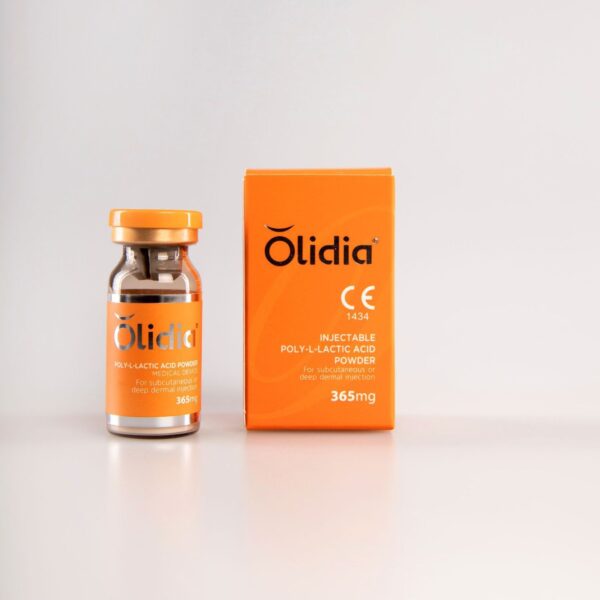

OLIDIA® PLLA Collagen Biostimulator (1 x 365 mg Vial) | DEFINE / PRAS (South Korea)
Short Description
Detailed Description
OLIDIA® is a sterile, non-pyrogenic, absorbable polymer biostimulatory implant manufactured in South Korea by PRAS Co., Ltd. / DEFINE. Designed as an advanced bio-equivalent alternative to first-generation PLLA injectables, OLIDIA refines the microparticle engineering process to optimize clinical handling, tissue integration, and safety.
While first-generation PLLA powders frequently feature irregularly shaped, jagged crystalline fragments that can cause mechanical micro-trauma, uneven distribution, and particle aggregation, OLIDIA utilizes controlled spherical microparticle synthesis:
-
Uniform Particle Diameter (40–63 µm): The particles are calibrated strictly within the 40–63 micron range—large enough to escape immediate macrophage phagocytosis, yet small enough to glide effortlessly through thin-wall 25G or 27G microcannulas without clogging.
-
Spherical Micro-Geometry: Smooth, rounded particle borders reduce local mechanical friction upon tissue contact, promoting a uniform, subclinical biological response without excessive foreign-body giant-cell reactions.
Tri-Phasic Mechanism of Action
-
Immediate Hydraulic Correction (Days 1–3): The sterile water and lidocaine vehicle fills structural hollows immediately post-injection. Within 48 to 72 hours, the aqueous vehicle is completely absorbed, returning tissue temporarily to near-baseline volume.
-
Controlled Subclinical Cellular Activation (Weeks 2–8): The evenly distributed spherical PLLA particles act as a biocompatible 3D scaffold. Host macrophages recruit resting dermal and subcutaneous fibroblasts, triggering progressive, high-yield synthesis of Type I collagen and surrounding extracellular matrix (ECM).
-
Hydrolytic Bio-Resorption & Native Redensification (Months 2–24+): The PLLA polymers slowly hydrolyze into non-toxic lactic acid monomers, which are metabolized into carbon dioxide ($CO_2$) and water ($H_2O$) via the endogenous Krebs cycle. Long after the synthetic microparticles are cleared, a dense, self-sustaining matrix of native collagen remains, preserving structural lift and tissue thickness.
Treatment Areas & Indications
-
Midface Structural Volumization & Deep Atrophy:
-
Deep temporal fossa concavity and lateral eyebrow descent
-
Submalar cheek depressions, flattened malar apex, and midface fat-pad volume loss
-
Deep nasolabial fold effacement
-
-
Lower Face Architecture & Vector Tightening:
-
Pre-jowl sulcus effacement and mandibular border definition
-
Chin shadow softening, mental crease structural correction, and marionette lines
-
Lateral cheek accordion smile lines and diffuse midface elastosis
-
-
Neck & Décolletage Rejuvenation (Hyperdilute):
-
Transverse cervical wrinkles (“necklace bands”) and severe horizontal creasing
-
Décolleté solar elastosis and sleep-induced cleavage creases
-
-
Non-Surgical Body Contouring & Skin Tightening:
-
Lateral pelvic depressions (hip dips) and biostimulatory gluteal volumization
-
Post-pregnancy periumbilical abdominal skin laxity and inner thigh crepeyness
-
Cellulite depression smoothing (subcision followed by hyperdilute PLLA fanning)
-
Key Clinical Advantages
-
Uniform Spherical Particle Morphology: Smooth, rounded microparticles minimize shearing forces, ensuring homogenous tissue distribution and a low risk of late-onset subcutaneous nodules.
-
Rapid Chairside Reconstitution: Unlike legacy PLLA powders requiring 24 to 48 hours of advance preparation, Olidia hydrates efficiently within 15 to 30 minutes (or via instant-shake protocols), streamlining clinic workflow.
-
High Extrusion Smoothness: The spherical shape and optimized carboxymethylcellulose carrier prevent needle or cannula blockage, ensuring continuous, predictable extrusion force.
-
High Biocompatibility & Safety: Synthesized from medical-grade, non-animal synthetic polymers with decades of safe clinical history in resorbable sutures and surgical plates; requires no prior allergy testing.
-
Long Clinical Longevity: Stimulates the patient’s own fibroblasts to produce durable Type I collagen, sustaining aesthetic volume and dermal redensification for 24+ months.
Reconstitution & Preparation Protocols
To ensure homogenous particle suspension and prevent clumping:
[Olidia 365 mg Vial] + 5.0–7.0 mL SWFI ──► [Vigorous Agitation 1 Min] ──► Rest 15–20 Min ──► + 1.0–2.0 mL 2% Lidocaine
| Application | SWFI Volume | 2% Lidocaine Volume | Total Working Volume | Recommended Injection Instrument |
| Standard Facial Volumization | 5.0 – 7.0 mL | 1.0 – 2.0 mL | 8.0 – 9.0 mL | 25G (50 mm) or 22G (70 mm) blunt cannula / 26G needle |
| Facial Tissue Tightening (Dilute) | 8.0 – 9.0 mL | 1.0 – 2.0 mL | 10.0 mL | 25G (50–70 mm) blunt-tip microcannula |
| Neck & Décolleté (Hyperdilute) | 10.0 – 12.0 mL | 2.0 mL | 12.0 – 14.0 mL | 25G (70 mm) blunt cannula (subdermal fanning) |
| Body Contouring (Gluteal / Hip Dips) | 12.0 – 14.0 mL | 2.0 mL | 14.0 – 16.0 mL | 18G or 22G (70–100 mm) body microcannula |
Technical Specifications
| Parameter | Specification |
| Product Classification | Injectable Poly-L-Lactic Acid Collagen Biostimulator |
| Total Lyophilized Cake Weight | 365 mg per vial |
| Active Substance | Poly-L-Lactic Acid (PLLA) microparticles (150 mg) |
| Inactive Excipients | Sodium Carboxymethylcellulose (CMC, 90 mg) + D-Mannitol (125 mg) |
| Particle Morphology & Size | Spherical, non-porous microparticles (40 – 63 µm) |
| Packaging Presentation | 1 x 365 mg sterile glass vial |
| Reconstitution Fluid | Sterile Water for Injection (SWFI) + 1% or 2% Lidocaine HCl |
| Target Injection Planes | Deep subcutaneous layer, immediate subdermal junction, or supraperiosteal bone |
| Recommended Injection Tools | 22G / 25G (50–70 mm) blunt microcannulas or 26G needles |
| Injection Techniques | Retrograde linear fanning, cross-hatching grid, or supraperiosteal micro-depots |
| Recommended Clinical Protocol | Induction: 2 to 3 sessions spaced 4 to 6 weeks apart; Maintenance: 1 session every 12 to 18 months |
| Expected Clinical Duration | Up to 24+ months (native collagen scaffold remains stable for 2 to 3 years) |
| Storage Instructions | Store dry powder between 2°C and 30°C (36°F to 86°F); once reconstituted, refrigerate at 2°C–8°C and use within 72 hours |
| Manufacturer / Origin | PRAS Co., Ltd. / DEFINE (South Korea) |
| Regulatory Category | CE-marked Medical Device / KFDA Approved / Prescription Only (Rx) |
Comparative Benchmark: Olidia vs. Sculptra vs. AestheFill
| Feature | OLIDIA® (DEFINE / PRAS) | SCULPTRA® (Galderma) | AESTHEFILL® (REGEN Biotech) |
| Active Polymer | PLLA (Poly-L-Lactic Acid) | PLLA (Poly-L-Lactic Acid) | PDLLA (Poly-D,L-Lactic Acid) |
| Polymer Content | 150 mg PLLA (365 mg total cake) | 150 mg PLLA (367.5 mg total cake) | 154 mg PDLLA (200 mg total cake) |
| Particle Morphology | Spherical uniform microparticles | Irregular, crystalline micro-flakes | Porous, patented micro-sponge spheres |
| Particle Size | 40 – 63 µm | 40 – 63 µm | 30 – 50 µm |
| Hydration Speed | Fast (15–30 minutes) | Moderate (15–30 mins with new protocol; historically 24h) | Ultra-Fast (10–15 minutes) |
| Extrusion Force | Low / Very smooth (spherical glide) | Moderate (requires continuous pressure) | Low / Highly fluid |
| Primary Indication | Deep facial volumization & body contouring | Deep structural facial volumization | Full-face smoothing, volumization, and skin quality |
| Clinical Durability | Up to 24+ months | 24+ months | 18 to 24 months |
Mandatory Post-Procedure Protocol: The 5-5-5 Rule
Because PLLA microparticles do not form a cross-linked gel matrix, physical mechanical dispersion post-treatment is essential:
-
The 5-5-5 Rule: Instruct the patient to massage all treated areas for 5 minutes, 5 times per day, for 5 consecutive days.
-
Clinical Purpose: Ensures the microparticles remain homogeneously distributed across subcutaneous planes, preventing focal particle aggregation and nodule formation.
-
Technique: Firm, circular massage using a clean barrier cream or arnica gel.
Professional Advisory: OLIDIA® is a medical biostimulant intended strictly for certified dermatologists, plastic surgeons, and credentialed aesthetic physicians trained in microparticle suspension delivery and facial anatomy. Direct injection into the hyper-mobile vermilion lip body, the infraorbital tear trough, glabella, or superficial papillary dermis is strictly contraindicated due to the risk of visible, fibrotic nodule formation.


Reviews
There are no reviews yet.